How much LED lighting saves: the calculation method
One formula, a tariff with its legal reference, an example on a 3,500 m² karting hall and a way to verify the saving by a measurement record rather than a promise.
Contents
A promise of “up to 70% savings” means nothing without a line of assumptions: how many hours the lighting runs, what the tariff is, what was installed before and how much light is left after the replacement. Below is the method our savings calculator uses, with numbers you can repeat on paper.
The formula: one for the whole calculation
Annual consumption is calculated twice, before and after the replacement:
kWh per year = count × power of one, W × hours a day × days a year / 1000.
Then three lines:
- saving in UZS = (kWh before - kWh after) × tariff;
- freed capacity, kW = (count × W before - count × W after) / 1000;
- payback, months = cost of the new luminaires / saving per year × 12.
And a fourth, without which the calculation sells savings at the expense of light: luminous flux before and after = count × flux of one luminaire. If the flux drops by more than 10%, the calculator shows a warning. The threshold comes from the acceptance rule of the Uzbek building code ShNK 2.01.05-24 (clause 178, table 26): measured illuminance no lower than 90% of the design value.
Where each number comes from
The power of the old luminaire includes the ballast, because the meter sees the lamp together with it: HPS 250 W is 275 W, HPS 400 W is 440 W, metal halide 250 W is 275 W, a 2 × 36 W fluorescent with electromagnetic ballast is 90 W, a 4 × 18 W is 108 W. These are lower estimates by the ballast classes of the EU regulations; the field in the calculator can be edited to match your own data sheet.
The flux of the old luminaire is the rating of new lamps from the Lisma, Philips and OSRAM catalogues: HPS 250 W 30,000 lm, metal halide 250 W 20,500 lm, 2 × 36 W 6,700 lm. Lamp depreciation and the efficiency of the old housing are not included, so the flux drop in the calculator is overstated: the error runs against us.
The flux of the new luminaire comes from the IES file where there is one: Prom 150W 19,500 lm, Prom 200W 26,000 lm, Line Ultra 40W 5,600 lm. The files date from 2018 and can be downloaded on the IES page. Where there is no file, the flux is calculated, and the result is labelled that way.
The tariff is 1,100 UZS per kWh including VAT for legal entities of tariff groups I, II and IV under annex 1 to Cabinet of Ministers Resolution No. 243 of 15 May 2026, in force since 1 June 2026. The resolution has no time-of-day zones or voltage steps; if you have a contract tariff, enter it, because the whole payback depends on it.
Hours and days are yours. The default is 12 hours and 300 days: two shifts on a six-day week. A warehouse at 14 hours and a car park at 24 hours are calculated differently, and that changes the payback twofold.
Example 1: one-for-one replacement
120 HPS 250 W luminaires replaced with 120 Prom 200W, 12 hours, 300 days:
- before: 120 × 275 × 12 × 300 / 1000 = 118,800 kWh;
- after: 120 × 200 × 12 × 300 / 1000 = 86,400 kWh;
- saving: 32,400 kWh × 1,100 = 35.6 million UZS a year;
- freed capacity: 9 kW;
- flux: 3,600,000 lm against 3,120,000, 13% less, warning.
Payback at the price from the model card is about 57 months. That is the honest result of a “lamp for luminaire” replacement against HPS: it saves 27%, no more. The example with these values opens in the calculator by default.
Example 2: a site calculated to the norm
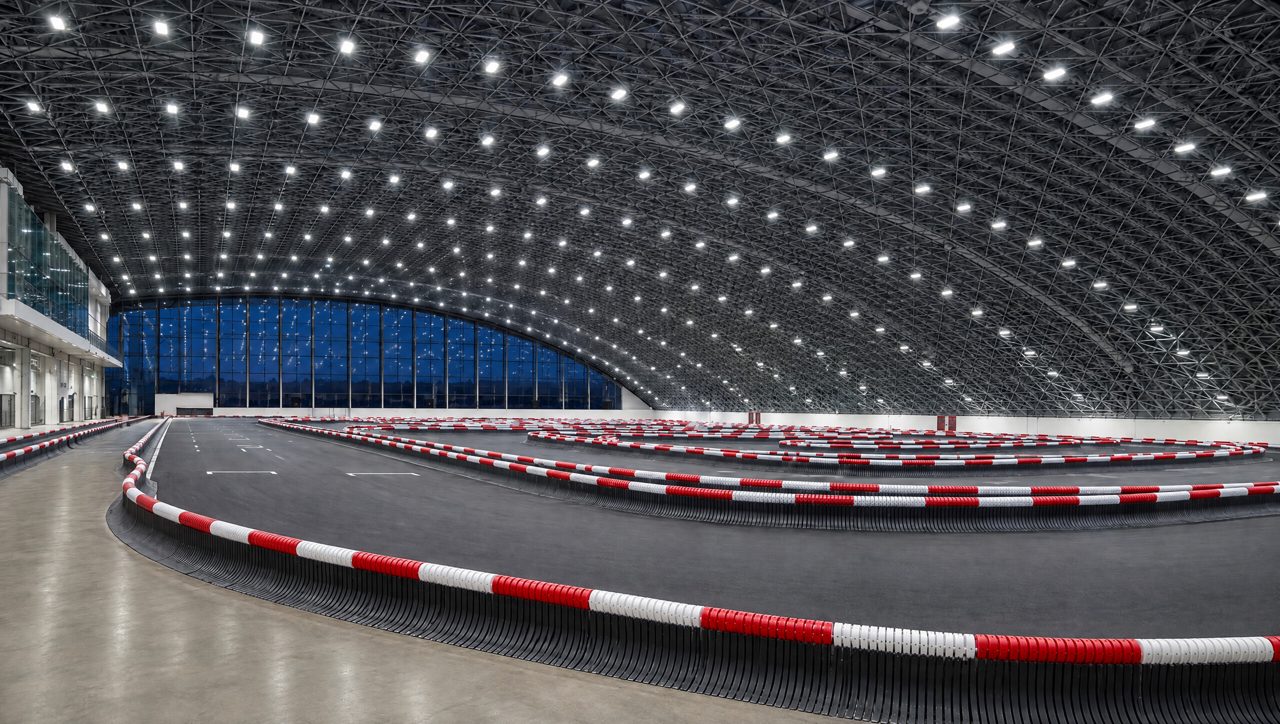
An indoor karting hall in Tashkent, ≈ 3,500 m², mounting height 8 m. The previous luminaires with control gear drew ≈ 66 kW and gave ≈ 120 lx on the track. 180 Prom 150W were installed: ≈ 27 kW and ≈ 300 lx.
- power difference: ≈ 39 kW;
- at 12 hours and 300 days: 39 × 12 × 300 = ≈ 140,400 kWh a year;
- at a tariff of 1,100 UZS: ≈ 154 million UZS a year.
2.4 times less electricity for light, 2.5 times more light. That happened not because the luminaire is brighter than the lamp, but because the site was calculated to the norm: the light goes onto the track rather than under the dome, and it does not fade the way discharge lamps do. Figures marked ≈ are estimates to be confirmed by a measurement record; more on the site on the karting hall page.
What the calculator does not count
- Installation, cable, circuit breakers and removal of the old luminaires.
- Maintenance: HPS and metal halide lamps have a rated life of 20,000 to 24,000 hours by catalogue, which means lamp replacement with an aerial platform every 3 to 6 years; an LED module has a calculated life of 50,000 hours. This is not in the calculation, but it shows in the enterprise budget.
- Mounting height, the target under ShNK 2.01.05-24 and uniformity: because of them the DIALux calculation usually needs fewer new luminaires than old ones. Example 2 is about that.
How to verify the saving by a measurement record
- Before the replacement, take the meter reading for the lighting circuit over a month, or record the operating mode: hours, days, installed power by data sheets.
- Measure illuminance with a lux meter over a grid of points on the working plane, at night, without daylight. This is the “before”.
- After installation, repeat both measurements. Illuminance is compared with the design value by the 90% rule (clause 178, table 26), consumption with the calculation at the same hours.
- Write the line of assumptions into the record: hours, days, tariff, maintenance factor. Without it no savings percentage can be verified.
We ask the same of ourselves: in a quotation the saving comes with a line of assumptions and the note “calculated, not guaranteed until measured on site”.
Frequently asked questions
Why not “three times less electricity”?
Because against HPS and metal halide lamps a one-for-one replacement gives 27% to 45% on power. Twofold and more comes on sites calculated to the norm, and we show it on our own sites with the ≈ sign, not as a property of the luminaire.
Is lamp depreciation taken into account?
No, and deliberately so. The minimum depreciation factors of discharge lamps (HPS 0.85 by 16,000 hours, metal halide 0.80 by 12,000 hours under EU Regulation (EC) No 245/2009) are not in the model, so the real difference in light on site is larger than calculated.
Which tariff to use if the contract says otherwise?
Your own. The tariff field in the calculator is editable, and the result carries a note of the tariff it was calculated at. 1,100 UZS is the value from Cabinet of Ministers Resolution No. 243 for legal entities, checked against the text of the resolution.
What do you confirm with documents, and what not?
Flux from the 2018 IES files, a 3-year warranty, production in Tashkent since 2014. Savings percentages, payback and case figures are calculated under the stated assumptions; the LM-79 test report on the assembled luminaire is in progress.